
Glitter Marker RFQs: Specify Each Colour Pair
For wholesale glitter markers with two ink colours in one pen, request a chart showing which colours are paired on the same physical unit. The QS-1166 page explicitly describes a dual-colour design and two glitter colours per pen. Ask the supplier to identify both ends and their offered ink references, then approve each pairing before using it in a quotation or sample decision.
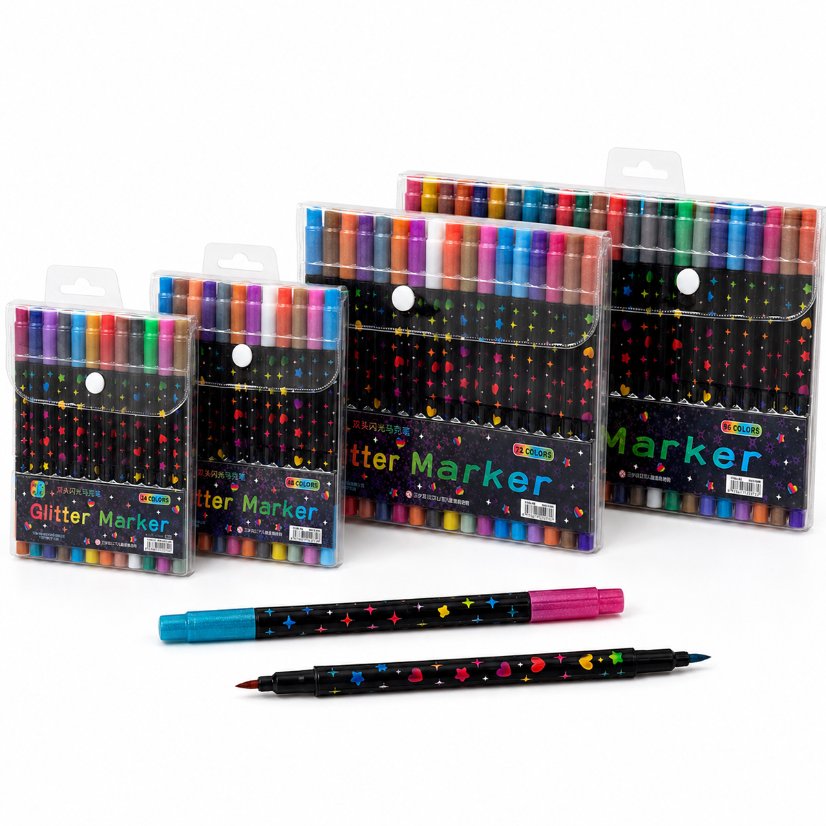
Official QS-1166 product reference showing packaged markers and individual double-ended pens. Use the actual offered version when requesting its colour-pair chart; the group image does not define a purchased assortment.
Start with the actual dual-colour product
Keep the QS-1166 Glitter Markers product link with the enquiry and ask for the supplier’s reference for the proposed version. Its description assigns two colours to one pen. The next purchasing question is which specific ink references make up each offered pair.
Ask whether the proposed pairings are fixed supplier combinations or another identified arrangement. If the buyer wants a particular pairing, submit it as a requirement for confirmation. The listing alone should not be treated as an offer to assemble any two requested colours together.
Give both ends an unambiguous reference
Ask the supplier to mark both ends on a photograph or drawing of one identified pen. A buyer can use temporary names such as End A and End B for discussion if the supplier confirms the orientation. Keep the marking convention with the chart so later replies refer to the same physical ends. Keep a dated copy of that marked orientation with the final chart, so subsequent sample photographs use the same convention.
Pair-chart field
Supplier response requested
Complete pen reference
Identify the physical unit carrying the pair
End A
Offered ink-colour identifier and orientation
End B
Offered ink-colour identifier and orientation
Pair reference
Code or accepted reference joining both entries
Different-model QS-Art catalogue image showing cap identifiers. This is an identification comparison only: its codes are not QS-1166 pair codes, and these markers are not included items or supply proof for the glitter-marker offer.
Request the actual pairing chart
Ask the supplier to list each proposed pen reference with both associated ink-colour identifiers. Keep the pair together on one row. If the supplier uses another naming system, retain its terms beside the buyer’s working identifiers rather than relying on an informal colour description in a sales message.
Where a submitted chart shows a broad palette without pairing information, ask which two entries share one pen. The buyer needs the assembly relationship between the colours. That relationship remains a separate selection decision even when all the colours the buyer wants appear somewhere in the supplier’s offered range.
Connect the cap markings to the ink references
Ask how the supplied pen identifies its two ink colours to the user. Request an explanation of the proposed cap colours, printed codes or other markings and their connection to the pairing chart. Treat the response as a product-specific mapping rather than borrowing identifiers from another marker listing.
If an end cannot be distinguished clearly in the submitted photograph, request a labelled view. Keep the agreed orientation visible beside both ink references. This lets the buyer discuss a mismatched marking or proposed change without confusing the complete pen identifier with the colour assigned to one end.
Different-family QS-288 highlighter catalogue image. It illustrates why a separate product reference must stay with each colour discussion; these highlighters do not establish QS-1166 ink colours, pairings or supplied contents.
Approve the two-colour unit as one sample
Request an identified complete pen representing each proposed pairing under review. Ask the supplier to connect its two ends with the chart entries and applicable colour references. Keep the submission and buyer decision together so acceptance concerns a particular two-colour unit rather than two unrelated colour names.
Identify the complete QS-1166 proposal.
Mark the two physical ends consistently.
Link both ink identifiers to one pair reference.
Record the sample and chart revision.
When one pairing is accepted and another remains open, record those decisions separately. Ask for a revised sample reference when either colour changes. An earlier decision should not silently become approval of a different companion colour on the other end of the pen.
Carry pair identities into the quotation
A focused enquiry can read: “Please provide the offered QS-1166 colour-pair chart. Identify both ends of each proposed pen, connect the cap or printed markings to the ink references and submit the selected pairings for approval.” Send the product link through the supplier contact page.
Ask the quotation to retain the accepted pair references and chart revision. If the supplier proposes changing one ink colour, request the complete revised pair for the buyer’s decision. Keeping the overall palette unchanged would not, by itself, preserve the original pairing arrangement.
Keep the final chart available for reviewing repeat offers. A named pair and its marked sample give purchasing a direct way to discuss a change without reconstructing the intended combination from the appearance of several packages.
Keep the evidence boundary clear
The two-colour description is a supplier declaration. No pen was opened or tested for this article, and photographs do not establish exact ink shades or glitter performance. Pair approval does not prove writing width, surface compatibility, drying behaviour, safety or durability. Obtain separate product-specific evidence for any required outcome; other-model images remain comparison references only.
Frequently asked questions
Does a palette identify which colours share a pen?
Request the actual chart connecting both ink references to one complete pen.
Can identifiers from another marker model be reused?
Ask for the offered QS-1166 marking-to-ink correspondence instead.
What changes when one end’s colour is substituted?
The proposed pair changes and needs an identified revised submission and buyer decision.
glitter markerscolour pairsend referencessample approval